By: Justine Brooks
4 Feb, 2026


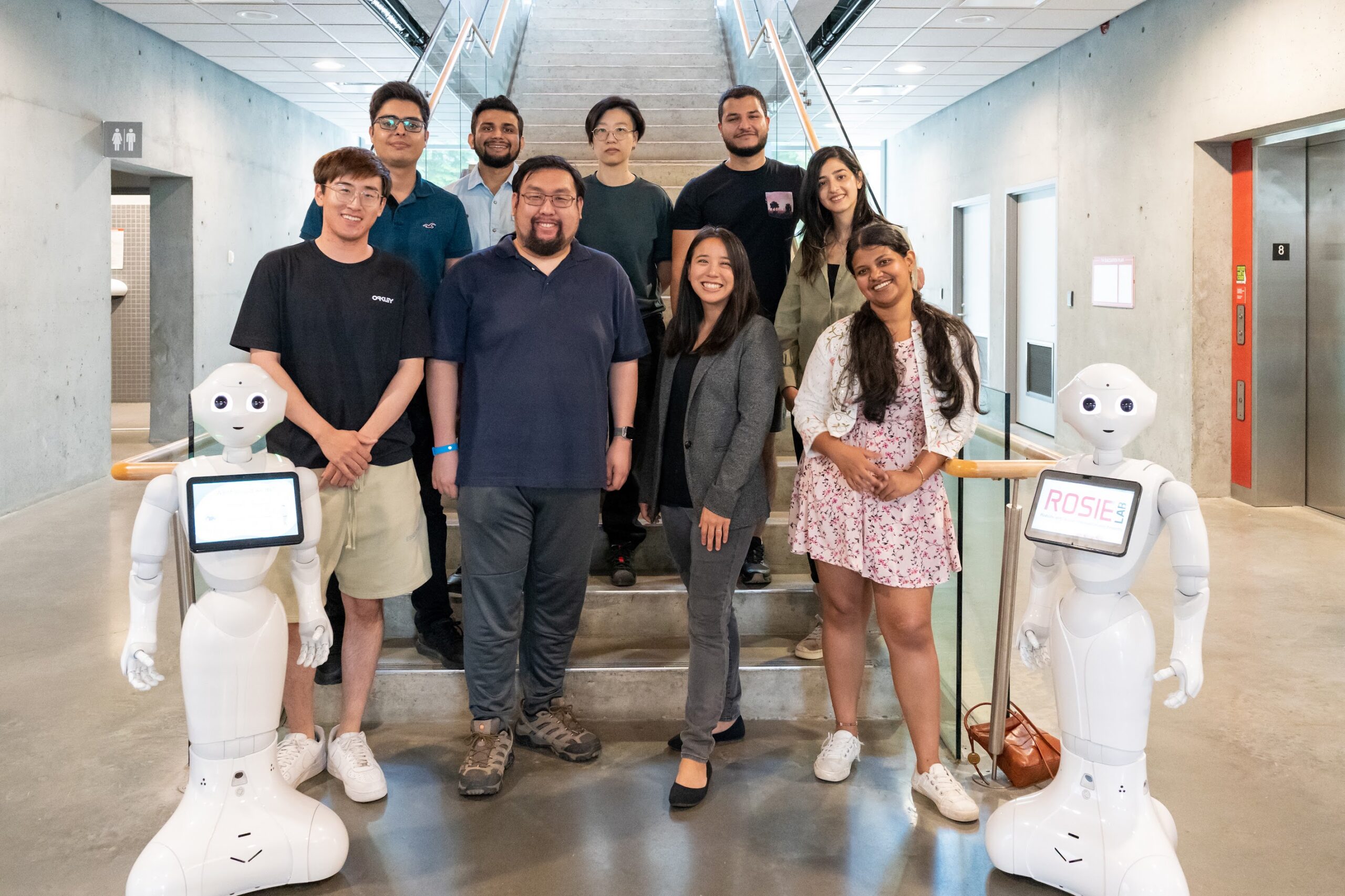
One of the newly appointed Canada CIFAR AI Chairs, Angelica Lim, is redefining the relationship between humans and machines through her research. An Amii Fellow and associate professor at Simon Fraser University, she is the head of the Robots with Social Intelligence and Empathy (ROSIE) Lab, which sits at the intersection of artificial intelligence and robotics, pushing the boundaries of how machines can understand and integrate with human life.
In an interview with CIFAR, Lim discussed the inspiration behind her work, the critical distinction between emotional intelligence and empathy in AI, and why she chose to return to Canada to further her career.
The impact of the [Canada CIFAR AI Chairs] program is huge because it allows me to be more flexible with my research. If I have an idea to work on AI safety, for example, I can immediately start working on this problem because I don’t have to worry about writing my next grant.
I’m also excited to meet others who are passionate about intelligence in one way or another and to potentially discuss our next steps as a country. When I was in Europe, I was sometimes called on at the EU level to provide my expertise on certain issues. I think there’s room for us to do that here, too. We’re all very driven by our own research, but thinking about how we can help at the national level is important.
The ROSIE Lab harkens back to that original robot from the 1960s cartoon The Jetsons, called Rosie, and the idea that one day we will have robots that can be useful in our physical world. What was cool about this robot was that it didn’t just know how to interact, it integrated in a way that was fun and acceptable for the family.
When technologies understand our full expressive form through gestures, voice and emphasis, instead of humans having to adapt to the technology, the machines learn how we naturally communicate. That’s what my research is really about – making machines that can interpret how we communicate.
I always thought that having a body was fundamental for robots to understand us. For example, what is a chair? You can say it’s got four legs and so forth. But if you think about it, a chair is anything you can sit on. Robots, fundamentally, have this potential to understand the world in the same way that we do because it shares our physical experiences.
Robotics interfaces well with AI because it helps us determine what we think AI should have in terms of understanding the world. For humanoid robots especially, these perceptive abilities are currently being explored through vision-language or vision-language action models. When we’re thinking about interacting with people, we need AI systems that can adapt to the people around them, not just be programmed once.
We’ve seen empathy in AI systems like ChatGPT, but to the point of too much empathy; it can be so overly agreeable and empathetic it has been thought to cause AI-induced psychosis, which can lead to delusions, hospitalizations and, in extreme cases, death.
Empathy, for me, means a robot has compassion, puts the human first and considers the other person’s needs. Emotional intelligence isn’t the only thing we want, because you can then get something with high emotional intelligence but no empathy, which among humans is associated with manipulation or even psychopathy. It’s a subtle space, but one I’m deeply embedded in and interested in getting right.
One of the big risks of companion robots is that people can get emotionally connected and reliant on them. For example, there was a robot called Jibo that kids were attached to and when the company went under, it was as if their robot died.
Many of these issues need to be addressed by policy to establish where the line is between entertainment and a health problem. I’m working on a proposal that will investigate what is happening in the brain when you interact with an AI so that policymakers have evidence that they can use to determine if it is detrimental or if there are ways that we can make it less harmful.

I’m actually American and Canadian. There was a choice between going back to my home state of California, where many startups are, or back to Vancouver. I’ve been very driven by helping and supporting other minorities in computing science and AI and Canada aligned with my values of inclusivity. Simon Fraser University is also top in Canada in computer vision which is very complementary for my work in robotics.
In terms of what makes Canada attractive overall, funding from the Natural Sciences and Engineering Research Council of Canada is really important, as it gives you the latitude to explore. Fundamental research leads to the groundbreaking AI discoveries that Canada is known for. It’s also encouraging that there are organizations like CIFAR that provide national support for this research.