By: Juanita Bawagan
2 Aug, 2018

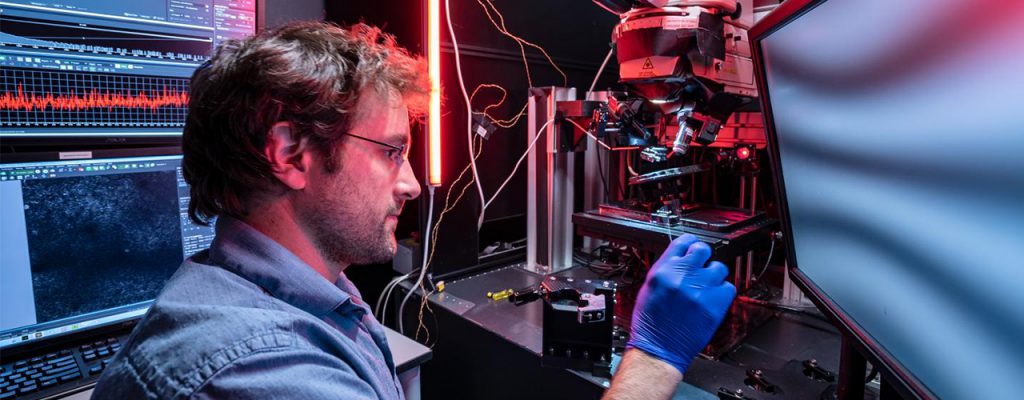
A shared “observatory for the mind” has been launched and CIFAR Learning in Machines & Brains fellows will be among the first to test it.
The Allen Brain Observatory is a standardized, high-throughput experimental platform built and run by a team of nearly 100 different experts with the common goal of understanding how the brain works by watching its neurons and circuits in action. Through the OpenScope program, launched by the Allen Institute on July 26, researchers from around the world can apply to run their own experiments in the observatory.
OpenScope is modeled after shared astronomy observatories that have been the seat of major findings about the physical universe.
“We seek to do the same in neuroscience, where we now have a brain-based observatory. What we’re doing here has never been done before,” said Christof Koch, Chief Scientist and President of the Allen Institute for Brain Science. “Rather than peering out at the blackness of the sky, we are peering inward at the brain, and we are doing it in such a way that the data is reliable, statistically valid and openly accessible.”
OpenScope will give researchers around the world access to the Allen Institute’s facilities to study the activity of hundreds to thousands of nerve cells in the visual cortex of the mouse.
Deep learning in the human brain?
One of the first OpenScope projects was proposed by a team of CIFAR researchers. The project aims to understand how learning in the visual system is coordinated between different parts of the brain, and how deep learning principles unearthed by the artificial intelligence community may have parallels in the mammalian brain. It builds on previous research on the potential of deep learning in the human brain by experimentally testing theory.
CIFAR Azrieli Global Scholar Joel Zylberberg (University of Colorado) leads the project. Additional collaborators include DeepMind Research Scientist Tim Lillicrap, CIFAR Fellow Blake Richards (University of Toronto Scarborough), and CIFAR’s Learning in Machines & Brain Program Co-Director Yoshua Bengio (Universite de Montreal).
“Rather than peering out at the blackness of the sky, we are peering inward at the brain, and we are doing it in such a way that the data is reliable, statistically valid and openly accessible.”
“The unique computerized facilities of OpenScope will help to explore how rodents learn when faced with unexpected circumstances,” Bengio said. “I believe this is just the beginning of a very exciting venture to make better sense of the learning principles in the brain at the network level.”
This project is one of three inaugural OpenScope projects. The other two projects underway are “Probing the brain’s response to biologically relevant movies” and “Investigating how experience and expectation influence the way the brain represents information using specific pathways.”
Currently, the observatory is focused on the mouse visual system. To run experiments, researchers show the rodents different images or movies and record cellular activity from the animals’ visual cortex in six different areas. Data collected from more than 65,000 different neurons.
The Allen Institute for Brain Science’s data and tools are publicly available online at brain-map.org.