By: Abeer Khan
19 Mar, 2026

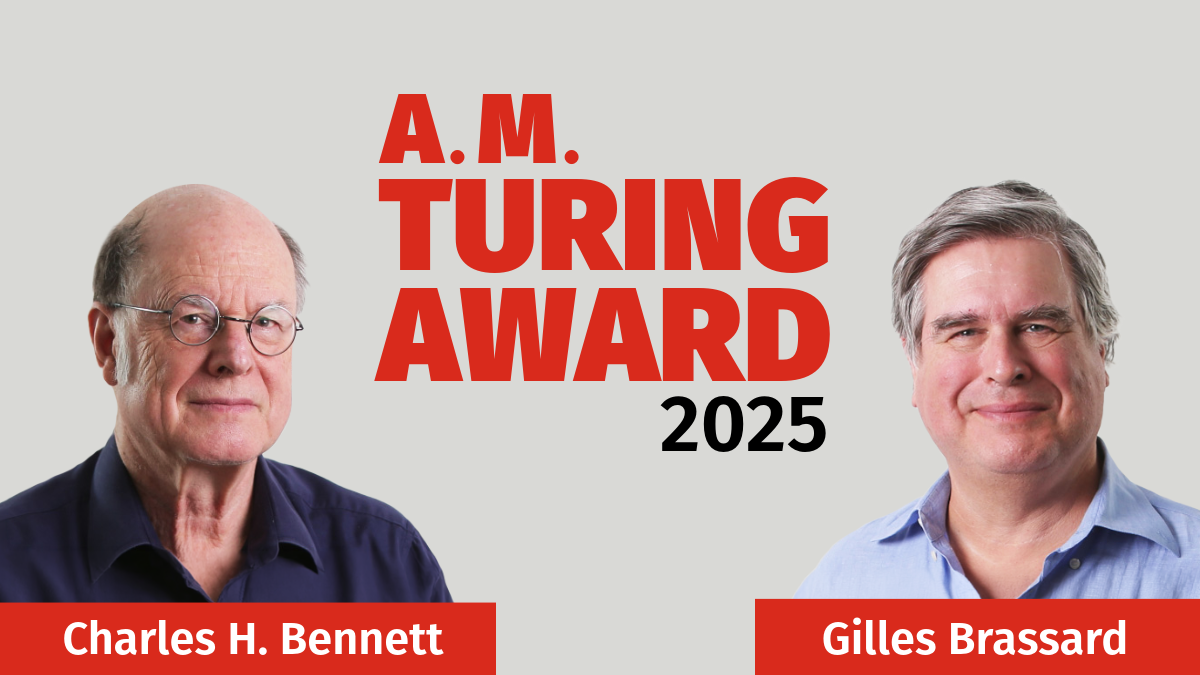
Longtime CIFAR members Gilles Brassard and Charles H. Bennett have received the 2025 ACM A.M. Turing Award for foundational contributions to quantum information science.
Brassard and Bennett received the award, often referred to as the “Nobel Prize of Computing,” for their role in establishing the foundations of quantum information science and transforming secure communication and computing. The Award carries a $1 million prize and is given by the Association of Computing Machinery for major contributions of lasting importance to computing.
In 2022, Brassard and Bennett were also awarded the Breakthrough Prize in fundamental physics — the world’s largest science prize — at $3 million. The Breakthrough Prize recognizes scientists who have made seminal contributions to human knowledge.
“I am thrilled to congratulate Gilles Brassard and Charles H. Bennett for being recognized with The Turing award,” says Stephen J. Toope, President and CEO of CIFAR. “This is an extraordinary honour and a testament to the lasting impact of their foundational work in quantum information science. It also serves as an exceptional example of the importance of investing in and conducting fundamental research.”
Brassard, a professor at the University of Montréal, has been an active member of CIFAR’s research community since 2002. He was initially appointed as a Fellow to the Quantum Information Processing program, which later became the Quantum Information Science program. Most recently, he has served as an Advisor to the program. Bennett served as an Advisor to both programs from 2007 to 2013.
“Since 2002, CIFAR’s Quantum Information Science program has played a formative role in shaping the field in Canada and globally,” says Kate Geddie, Executive Director of Research at CIFAR. “Gilles and Charles’ work has been central to forwarding quantum research, and created a strong, connected ecosystem that continues to thrive today.”
Bridging the gap between physics and computer science
Brassard and Bennett are recognized as the founders of quantum information science, which bridges the gap between physics and computer science by using quantum-mechanical phenomena to process and transmit information, rather than treating them merely as properties of matter.
Their 1984 paper, “Quantum Cryptography: Public Key Distribution and Coin Tossing,” introduced the first practical protocol for quantum cryptography. They demonstrated that two parties can establish a secret encryption key protected by the laws of physics – safe even against powerful quantum computers.
As the world approaches large-scale quantum computing in the coming decades, quantum cryptography will be a key factor in securing digital communications, especially in financial settings.
Brassard and Bennett have also reshaped the theoretical foundations of computing. Alongside collaborators, they introduced quantum teleportation in 1993. The group demonstrated how an arbitrary quantum state could be transmitted between distant parties using quantum entanglement – behaviour of particles too far apart to influence one another – and classical communication. This showed that entanglement could serve as a practical resource.
“Bennett and Brassard fundamentally changed our understanding of information itself,” said Yannis Ioannidis, President of ACM, in a recent press release. “Their insights expanded the boundaries of computing and set in motion decades of discovery across disciplines. The global momentum behind quantum technologies today underscores the enduring importance of their contributions.”