By: Liz Do
22 Jan, 2026

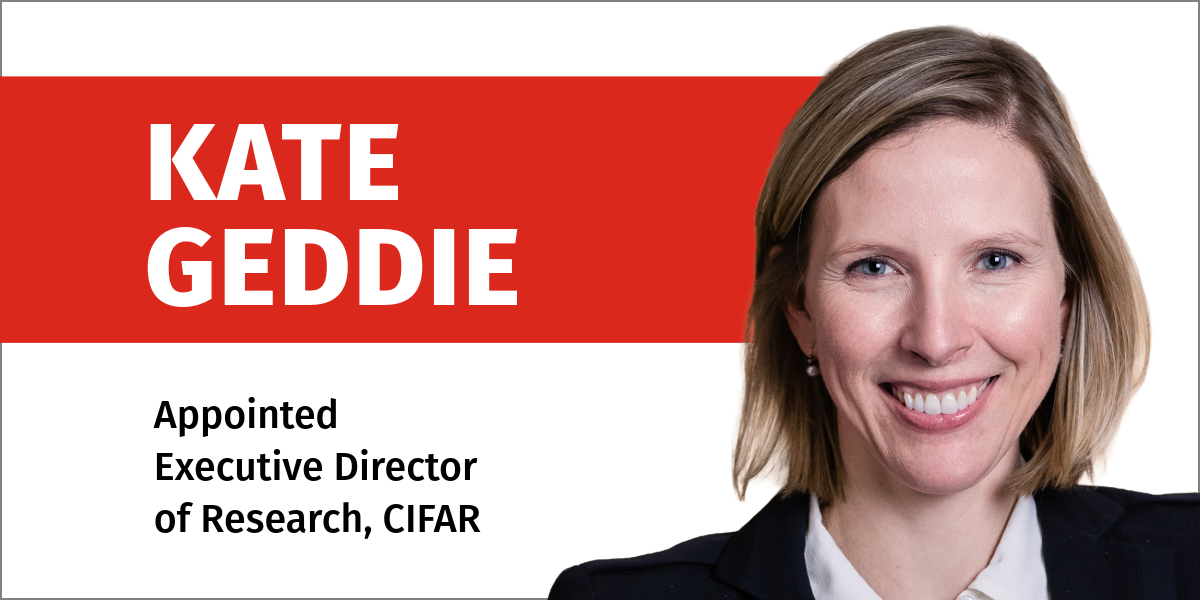
CIFAR is pleased to announce the appointment of Kate Geddie as Executive Director of Research, effective February 1. Geddie has served in the role on an interim basis over the past year and was appointed following a comprehensive and competitive international search.
In her interim role, Geddie has provided steady, thoughtful leadership across CIFAR’s research portfolio. She has strengthened strategic alignment, advanced the organization’s evaluation and learning work, and supported its research department through a period of growth and transition.
As a member of CIFAR’s executive team reporting to Stephen J. Toope, President & CEO, she will continue to provide strategic leadership and oversight of CIFAR’s global research programs, ensuring alignment with the organization’s Strategy.
Geddie brings deep experience in global, interdisciplinary research and research leadership across Canada and Europe. Prior to joining CIFAR, she led public policy research and analysis on higher education, research and innovation, and has held roles at the University of Toronto, the European University Association in Brussels and Universities Canada in Ottawa. Her research has been supported by the Social Sciences and Humanities Research Council of Canada (SSHRC), the European Commission and the Swiss National Science Foundation.
“I’m honoured to continue serving CIFAR in this role and to work alongside such extraordinary colleagues and researchers,” said Geddie. “I’m excited to strengthen our partnerships, enhance how we evaluate impact and continue supporting researchers as they pursue bold ideas.”
“On behalf of the entire CIFAR team, I’m delighted to congratulate Kate on this well-deserved appointment. She has provided tremendous leadership across CIFAR’s research portfolio over the past year,” said Stephen J. Toope, President & CEO of CIFAR. “Her deep experience in global, interdisciplinary research and deep understanding of CIFAR’s mission enable us to strengthen our research portfolio, advance new and bold research directions, as well as support our ever-growing global research community.”