By: Abeer Khan
18 Nov, 2025

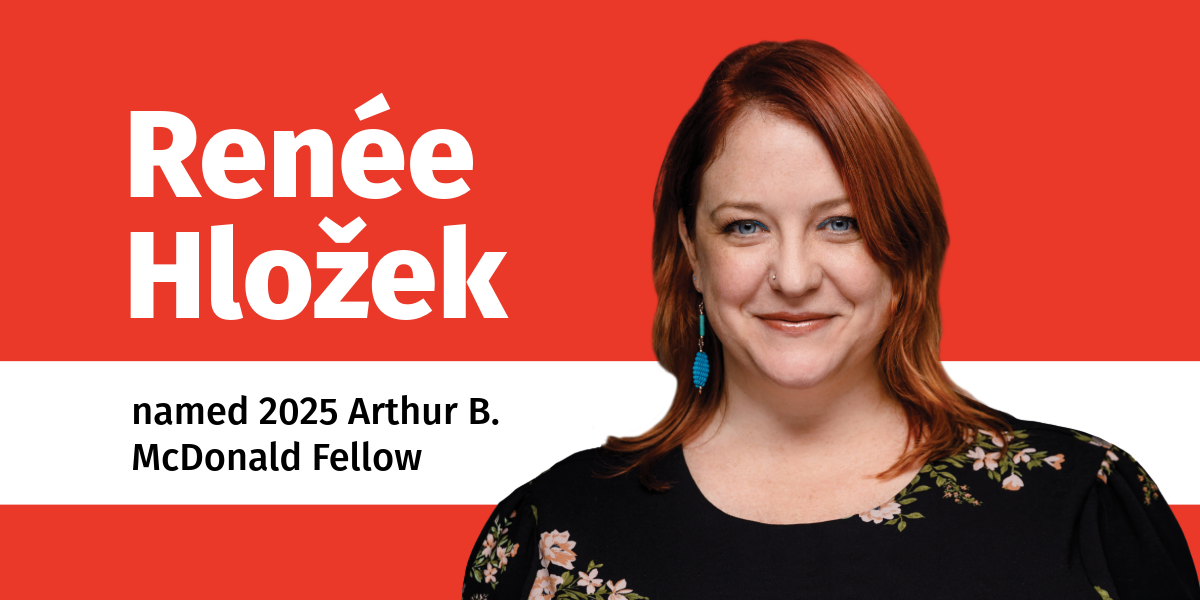
Renée Hložek studies the Universe — from its earliest moments to the far future — using statistical methods and precise observations to answer cosmic questions.
Recently, Hložek was awarded an Arthur B. McDonald Fellowship from the Natural Sciences and Engineering Research Council of Canada (NSERC), which recognizes early-stage academic researchers in the natural sciences and engineering, and supports them in enhancing their research capacity to become leaders in their field and inspire others.
Appointed as a CIFAR Azrieli Global Scholar in the 2019-2021 cohort, Hložek joined CIFAR’s Gravity & the Extreme Universe research program, where she received funding to develop and lead high-risk, high-reward interdisciplinary research and was connected to a network of researchers in her field. Today, she credits that experience for helping her achieve new feats in her research.
Currently an Associate Professor of Astronomy and Astrophysics at the University of Toronto, her work involves taking measurements of both visible and microwave light using telescopes located high in the deserts of northern Chile as part of the Vera C. Rubin Observatory and Simons Observatory collaborations. She uses these measurements to learn about the fundamental building blocks of nature. Hložek is also bridging the gap between astronomy and neuroscience, using image analysis methods from cosmology to study brain cell activity and the early signs of neurodegeneration.
We spoke with Hložek about her new fellowship, how the Global Scholars program has accelerated her career and the ambitious questions she’s exploring to understand the Universe’s deepest mysteries.
Q: What are the biggest cosmic mysteries your research is trying to solve?
A: My research focuses on what the universe is made of and how it evolves in time. We are trying to understand the components of dark matter and dark energy, since they make up so much of our cosmos.
Dark matter is matter that does not interact strongly with light. (It’s better to think of it as “invisible matter” more than dark matter.) Dark energy is better thought of as a force acting in opposition to gravity, pushing the universe apart and causing it to expand at an increasingly faster rate.
Q: How did your time as a CIFAR Azrieli Global Scholar shape your research journey?
A: I was elected as a Global Scholar in 2019, and this really shaped my entire journey as a researcher. That early investment in me and the community of creative scholars that I met in the Global Scholars community was transformative. The concrete support from CIFAR and the learning opportunities the CIFAR Azrieli Global Scholars program provided also made me a better scientist, scholar and leader of my research group.
Q: What was the highlight of your experience as a Global Scholar in the Gravity & the Extreme Universe program? Is there a moment that stands out to you?
A: Through CIFAR, I met Flavie Lavoie-Cardinal, a colleague working in neuroscience — a completely different discipline from myself — and we embarked on an interdisciplinary research journey kick-started with CIFAR Catalyst Funds that has generated a totally new research avenue that is delivering some promising results. We are using astronomy tools and methods, including image analysis and anomaly detection methods, to study neurodegeneration in the brain. As it turns out, in both fields we use observations of either the sky or the brain and are searching for faint signals against a fluctuating background. It has been so enriching to work across boundaries and look for common tools and approaches. We have grown the collaboration and now work with Christian Gagné and Audrey Durand, Canada CIFAR AI Chairs at Mila, and astronomy colleagues Daryl Haggard, Jess McIver and Ashish Mahabal, in thinking about machine learning interpretability, cross-training AI and machine learning methods and more.
Q: Why is investing in early-career scientists so important, and how did early-career funding make a difference in your own work?
A: Early in your career, you are finding your feet and trying to develop a sustainable research agenda. Universities and departments can be busy, and that means you do not get that much guidance or direct advice. Investments of financial support, but also the kind of mentoring provided by the CIFAR Azrieli Global Scholars program, really make all the difference.
Q: As an Arthur B. McDonald Fellow, what research will you be focusing on, and what excites you most about this next chapter of your work?
The fellowship comes just as my two dream observatories, the Vera C. Rubin Observatory and the Simons Observatory, come online, so I will be busy analyzing the amazing data these two telescopes will provide. In addition, I am going to plan and develop interdisciplinary astronomy-neuroscience projects during my fellowship. Finally, I want to think about how I can help support outreach organizations with the same direct mentoring and support that I’ve received over the years. I can’t wait to get started!