By: Justine Brooks
2 Oct, 2025

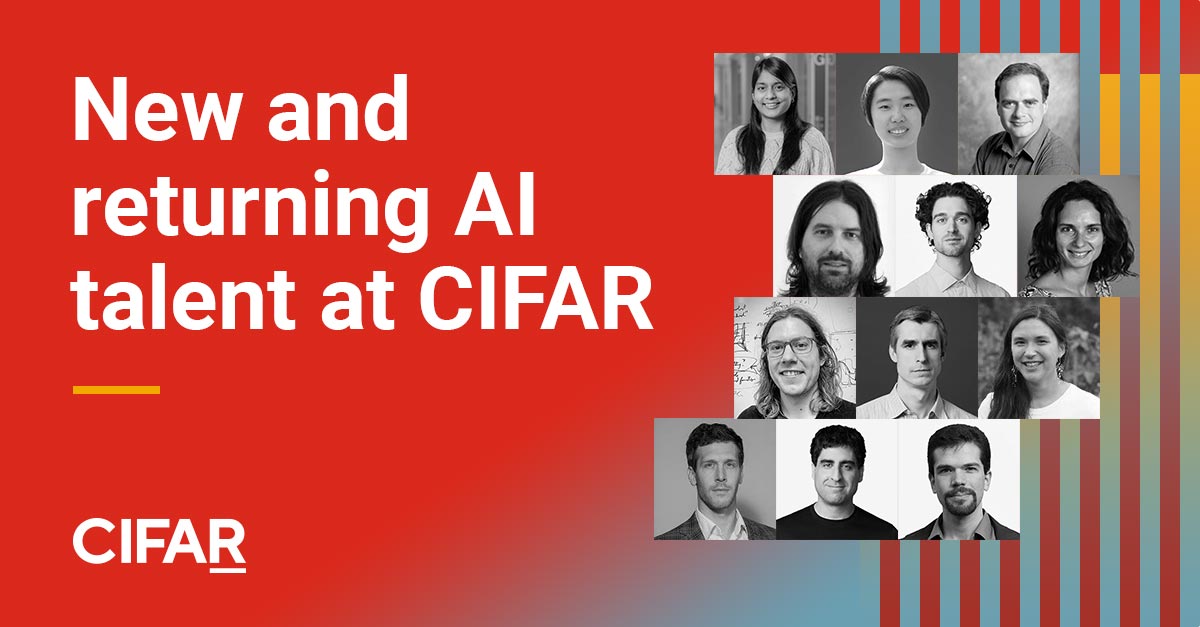
Advancing the fundamental science of AI, creating new technologies that fuel Canada’s economy and developing solutions to global challenges are among the central impacts that the Canada CIFAR AI Chairs program is having. A cornerstone of the Pan-Canadian AI Strategy, the Chairs program is pleased to welcome two new and ten returning world-leading AI researchers. Each Chair, affiliated with one of Canada’s three national AI institutes, receives five years of dedicated funding to pursue transformative research ideas and train the next generation of innovators. The program is the bedrock of Canada’s strength in AI research and talent.
CIFAR congratulates the following new and renewed Canada CIFAR AI Chairs:
Vector
Mila
In a Q&A with CIFAR, the Chairs recently discussed their research plans, what they’re most looking forward to during their term, and the impact of the Canada CIFAR AI Chairs program.
Zhijing Jin: : My research focuses on the intersection of causality and natural language processing, with particular emphasis on developing AI systems that can reason about cause and effect. A key project is our Causal AI Scientist agent, which leverages large language models (LLM) to conduct scientific investigations autonomously, analyzing data and testing hypotheses much like a human scientist would.
During my term, I aim to establish Canada as a leader in causal AI and responsible AI deployment. I plan to expand our Causal AI Scientist platform to enable breakthrough discoveries across natural and social sciences, making it a valuable tool for researchers worldwide. I will continue building our multi-agent simulation frameworks to better understand AI behavior and inform AI safety measures. Through mentoring enthusiastic students and forming strategic partnerships, I hope to create lasting infrastructure for AI research that prioritizes both scientific excellence and societal wellbeing.
ZJ: I’m most excited about the opportunity to scale up our vision of AI as a force for scientific discovery and social good. The Chair position will enable me to build a larger, more diverse team of talented researchers who share my passion for pushing the frontiers of causal AI and responsible deployment. This appointment will allow me to accelerate our work on making AI a trusted partner in scientific research while ensuring we proactively address the societal implications of increasingly integrated AI systems in everyday life.
Gauthier Gidel: Canada CIFAR AI Chair funding has had a pivotal impact on my research in several areas. It allowed me to pursue high-impact long-term research topics by funding a vibrant research group. In particular it allowed me to fund a postdoc (Quentin Bertrand) early in my career which has been a huge success. Together we have been pioneering the theory of iterative retraining (generative models trained on their own synthetic data).
Liam Paull: The Canada CIFAR AI Chair funding has had an invaluable impact on my research program at the University of Montreal and Mila. The funds are unrestricted, which allows me and my students to explore a wide diversity of ideas and follow our intellectual curiosity, which has consistently resulted in a stronger output. My students and I have benefited greatly from the privilege of being able to conduct this type of “slow science”.
Aishwarya Agrawal: [The program] allowed me to pursue an ambitious and impactful research agenda that requires long-term funding. It also allowed me to hire many international students to cultivate a research group with diverse perspectives which in turn results in increased innovation and creativity.
Siamak Ravanbakhsh: Not only has the Chair [program] enabled long-term planning, but more importantly, it has enabled risk-taking and spontaneous exploratory research in my group.
David Rolnick: The funding has also supported students working on high-risk harder-to-fund areas.
Michael Brudno: The Canada CIFAR AI Chair award is an integral part of my research. It helps me recruit the best and brightest students and postdocs into my research program, provides my team with access to cutting-edge hardware and connects me with scientists from across Canada and internationally, opening avenues for me to be involved in projects that would not be possible otherwise.
Courtney Paquette: My CIFAR affiliation has been great for connecting with researchers across Canada that I probably never would have met otherwise. Between [AICan – the annual meeting of the Canada CIFAR AI Chairs program] and the various inter-institutional meetings CIFAR organizes, I’ve built genuine relationships with colleagues at universities across the country. It’s made the Canadian AI community feel much more connected and collaborative, which has strengthened my research.
Eilif Muller: Absolutely! The program has been a huge help to establish new connections within the Canadian AI research ecosystem since I moved to Canada.
Gauthier Gidel: Thanks to the first Canada CIFAR AI Chair award, I could build a research group that is aligned with my philosophy. Now that there is momentum in my group, I am excited to go full speed on achieving my research vision.
Liam Paull: The field of robotics has arguably over-promised and under-delivered. Many seemingly-simple problems that require interaction and understanding of the physical world have proved difficult to get machines to do in a robust and generalizable way. With the development of state-of-the-art generative models, we may be able to endow robots with more intuitive general knowledge of the world. This, combined with larger-scale robotic interaction data and videos, seem finally poised to really unlock this problem. I am very optimistic about the progress that will be made in robotics research during my Canada CIFAR AI Chair appointment, and am very excited to be a part of it.
Christian Gagne: With the renewal of my Chair appointment, I intend to explore approaches to better understand and explain decisions of AI models. In particular, we are looking to improve how the decisions are made by providing reasonings in a form that would allow both humans to better understand the decisions and machines to make verifications over these reasonings to ensure they are safe and fair.